
My Blacksmithing Story
Imagine yourself as a townsperson the the 1850’s, what is on job that every town had? Among others my favorite is the Blacksmith. In part because it was a very important job for the time period and because it can give me something that nobody else has. Something I can call my own.
I first became interested in blacksmithing when I came across a YouTube channel, Alec Steele. as I watched his videos I kept thinking, “Wow, that doesn’t even seem that hard to do,” “why haven’t I heard of this before?” So I tried to do it myself. One day in the woods, I had a hammer, hot nail, and a vise to use as an anvil. after about 15 seconds the nail had cooled too much, so I put it back in, but, I noticed that it had changed, I had done my first piece of blacksmith work albeit, in a very crude and primitive way. I brought it in after it had cooled and showed Dad. He silently put it in the back if his brain. Grandpa however gifted me an extra piece of railroad to use as an anvil.
Later, at Christmas, Dad gifted me a trip to forge my own knife. He also gifted me a pair of tongs and a cross peen hammer. I still use that hammer and tongs when I, my brothers, and Dad forge in the summer.
I learned a lot on my own and from my research and I am still learning. When I was given the hammer and tongs I was also given a book, A Blacksmithing Primer, by Randy McDaniel
Working Iron: A primer on Blacksmithing
https://www.artofmanliness.com/skills/craftsmanship/blacksmithing-primer/
Since most people don’t know a blacksmith, I get a lot of questions about the trade. Even strangers walking past my shop (the half of my garage) stop at the sound of hammers on steel and sheepishly wait for me to see them since I’m wearing hearing protection. I usually stop and answer questions, especially if there are children in the group.
“Where’s the coal?”
Many blacksmiths still use coal, and there are good reasons for it. You can get fast heats, and a skilled smith can manipulate the heat along a long piece of steel. The downside is that coal’s dirty, which is fine if you have a detached shop. I use propane because it’s clean, relatively inexpensive, and the neighbors downwind don’t need respirators.
“Where do you get steel?”
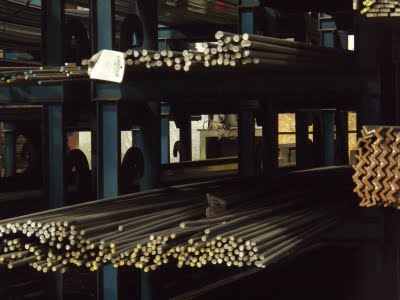
From a steelyard. We have lumberyards for lumber, and steelyards for steel. While lumberyards are fairly common in most places, steelyards are harder to find as they rarely cater to the public at large, mostly because no one in the public at large wants a 20’ piece of hot-rolled 5/8” diameter A36 steel rod. They’re usually found in industrial parks and such. Mine is a family-owned fourth-generation business, and they’re wonderfully kind to a guy who spends little money there compared to the trucker loading a flatbed with tons of steel tubing.
“How hot does it get?”
Very hot. 1400 degrees, big F. I can make it hotter or colder, but I usually keep it right around there. Welding heat and tool steel can require more heat.
Then there’s the statement: “I bet it feels really good to pound out all your frustrations…”
No, indeed. Hitting hard is part of the equation, but hitting accurately is more important. If a blacksmith is frustrated, he oughta go punch a bag until he gets over it, then go work at the anvil. More on that later.
Below I discuss the very basics of getting started in blacksmithing. You probably won’t be able to start blacksmithing right after reading this, but hopefully it will pique your interest enough to look more into this manly skill and trade. First, we’ll take a look at the basic tools you need to get started with blacksmithing. We’ll end by showing you the three fundamental ways of hitting hot metal in order to shape it.
The Tools
You need four basic things: A thing to heat your work, a thing to hold your work, a thing to put under your work, and a thing to apply forces to your work.
A Thing to Heat Your Work
Here’s my small forge.
You heat your work with a forge. Forges need fuel and air, and lots of it. Whether it’s a coke forge (coke is a material made from coal) with bellows or a propane forge with a fan, the basic idea is to apply heat to a piece of metal. Propane allows a little more control, although a master blacksmith can make a coke forge heat the work to a perfect temperature. Many (like me) use propane for its convenience and cleanliness.
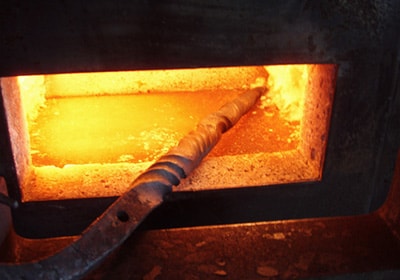
You can do a lot with a smaller forge. It wastes less energy and heats more quickly. A coke forge has an advantage here as it can be scaled easily, making the fire larger or smaller depending upon your work.
A blacksmith from the 18th century would have killed for an acetylene torch. The techniques for applying heat in small areas with a forge required amazing skills and several assistants helping to position and cool the work where heat wasn’t wanted. A good torch, both for cutting and for heating, is critical. The rosebud tip on my acetylene torch puts out 40,000 BTUs. For reference, our furnace puts out 60,000 to heat our entire house. So yeah…a lot of heat in a small space. That makes isolating decorative twists in metal much easier.
An acetylene torch in action. I’m heating the metal with the torch to make a twist.
A Thing to Hold Your Work
You hold things with tongs, vises, or clamps. As my dear mentor Larry says, “If you can’t hold it, you can’t hit it.” Tongs are primary, and a good smithy (the place a blacksmith works) has many tongs for holding various shapes. A tong that’s good for a ½” square rod will fail if you try to hold a ¼” round rod. Holding a flat piece of stock requires a different tong.
Different kinds of tongs for holding different shapes of metal.
A good vise is a godsend. If you buy a vise at Home Depot, I guarantee it would disintegrate within five minutes of the abuse I pile upon my Welton. Tools are not cheap, nor should they be. In this case, I’m holding an ice chisel made for a friend.
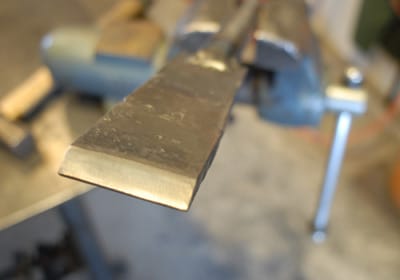
Clamps are also critical, especially if welding something that needs to be squared and flat. Holding something square or flat is tough without a large, stable surface and a method to stabilize it.
A Thing to Put Under Your Work
The something under the work is usually the anvil. A good anvil is critical to successful work. There are $200 anvils out there, and they’re good for boat anchors or something to be dropped on roadrunners.
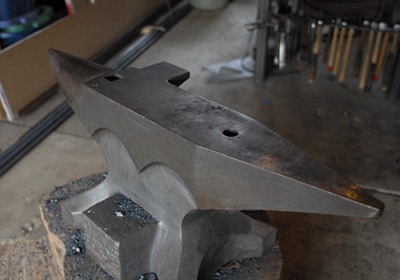
My anvil cost the most of any tool I have except my Miller 251 welder, and it was a close one on that. American-forged, the Rat Hole is a fantastically designed tool. It has two holes on it, the pritchel and the hardy (sometimes hardie) hole.
A pritchel is used for punching through a piece of metal, as you need a place for the slug to go when you get through the piece of work. It stabilizes the main piece of work so it doesn’t distort too much when you start punching.
The hardy holds a number of cool tools like a V-block, useful for putting a bend in a piece of stock, like making the curvature of a leaf, etc. It can hold a swage for putting an edge on a piece of stock or making a notch in a piece of flat stock.
There is an upsetting block on the back side (a very nice feature) and of course, the horn, which is the pointy part used for curving metal.
A Thing to Hit Your Work
We’re talking hammers here. You can skimp on tools in different places, and you’ll always be sorry, but that’s doubly true with hammers and anvils. The variety of shapes, weights and head styles will become obvious shortly.
There are many more tools that make life easier and more productive, but this is an introduction. More technical stuff will come down the road, like power hammers. I love/lust power hammers.
Shaping Metal
When working with hot steel, the best analogy I’ve used is that metal becomes a lot like clay when heated. Your job is to shape it like you would clay. To make things long and skinny, you can grab a piece of clay and stretch it, and it just breaks. Unfortunately, it takes a bit more work than that to stretch a piece of metal. Steel is not Silly Putty.
You use basic forces to move your metal. To make a long, skinny piece out of a short fat piece, you squeeze the sides of the metal, and turn the work. If you take a square of clay and squeeze it on the four sides repeatedly, it eventually becomes a long, thin polygon.
There are three fundamental ways to apply force (again, there are more, but we’re keeping it simple).
Drawing Out. This is the basic idea behind the cube of clay. Hit the metal on four sides again and again and it draws out into a longer piece. One of the quintessential applications of this is to make a nail point, where you create a four-sided pyramid by repeatedly hitting and turning your work, but using the hammer to angle the tip rather than hitting it flat. This is how old blacksmiths made their nails.
Upsetting. This is applying force to the end of a piece of work to “mushroom” the metal out to add volume to a piece. If you’re making a piece that needs some heft on an end, like a wide chisel, you use upsetting.
Peining. This is applying force to move the metal in a certain direction. You can move the metal in one direction or you can spread it in all directions. If you karate chop a piece of clay, it spreads out away from your hand parallel to the axis of your hand. If you take a fist and hit it, it spreads out in all directions.
The little ball on the back of your hammer is called a ball-pein. It’s designed to move metal out in all directions. See? Useful. I use a small ball-pein hammer for riveting through two pieces of metal to tie them together. The little mushroom you see on a metal rivet is the result of a ball-pein.
There are other types of peins, like a cross-pein, to spread metal out on one axis–like karate chopping that piece of clay. If I am making a leaf on a piece of stock, I will often cross-pein it to give the leaf more width. Willow leaf: not cross-peined. Aspen leaf: cross-peined.
Let’s apply some of these simple forces. Here are a few examples.
Drawing Out:
We start with a piece of 3/8″ square stock. Get it hot.
First, we upset using a flat hammer, a pretty heavy one, 1000g, or 2.2 pounds. The larger the hammer, the greater the force applied per hit. Sledges will make short work of a small piece. Drop a ten pound weight on a piece of clay: squish. I scale the hammer to the work size.
We’ll create a nail point by drawing out.
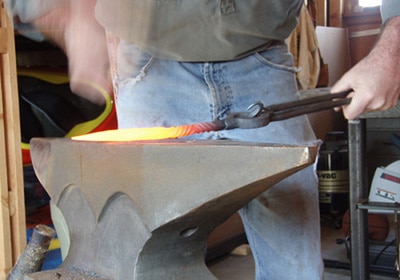
I had already put a twist in the work: ignore it for now. I work at the edge of the anvil here, to allow me to put a fine point on the work. I then turned the work 45 degrees and put another edge to make an octagon. Take the edges off the octagon and you have 16 edges. Continue, and you have a cone, but here I left edges to accentuate the twisting.
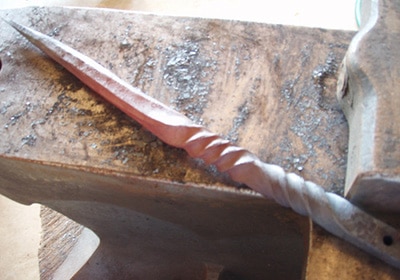
It takes multiple heats sometimes, meaning you’ll have to re-heat the metal in the forge so you can keep shaping it. Don’t hit the work when it’s cold…it can create a cold shunt that weakens the work. A cold shunt is where the hot and cold parts shear and create a weak spot. That’s no bueno.
Upsetting:
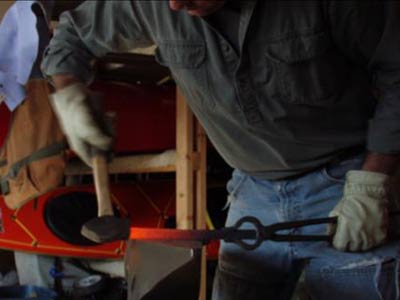
This is where we add volume to an end to start something like a chisel. It’s a little tougher because tool steel requires more heat and is harder at lower temps. Simply using the weight of the piece works quite well. You can also upset at the edge of the anvil, driving metal back toward yourself. Small, not huge hits move metal better and under more control. See how it’s starting to mushroom out?
Peining:
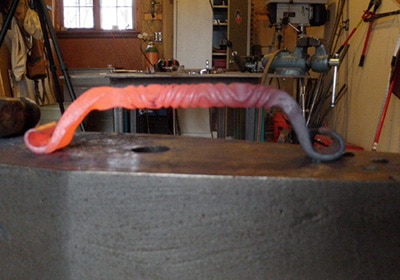
Here I’m spreading the ends of a piece of stock to make a set of drawer pulls for my wife. A lot of the curtain rods, drawer pulls, and candlesticks in my house were made in the shop, and she wanted to have some pulls for the bathroom. I used a ball-pein here to move the metal, then smoothed it out with the flat face of a hammer.
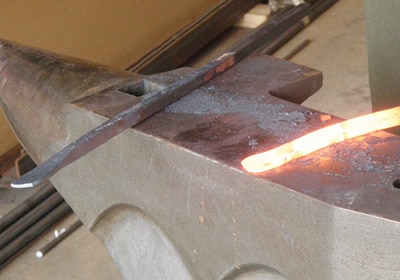
Then I roll over the edge, put a few bends in the work and voila, drawer pull.
—
A few other notes:
The essence of blacksmithing is not so much strength as control. Yes, you need to “get it hot and hit it hard” sometimes, especially with larger work, but the trick is to hit the metal where you want, as hard as you want as accurately as you want. When I first started working with metal more than a decade ago, my mentor drew an X on the anvil. “Hit there, move your work.” Chasing your work will result in a ruined piece or at least some cut marks, caused by hitting with the edge of a hammer and not the face.
There is a Zen-like beauty to having that sort of power and at the same time, that sort of control. Like everything worthwhile, it comes with time and practice. If your mind is cluttered, turn off the forge, clean your shop, and go back in the house. Clear mind means good work. I can tell when I make something if I was distracted. It goes in the scrap bucket for another day. Which leads me to…
There are no mistakes. Unlike wood, where you can cut it three times and it’s still too short, metal is recyclable. If a piece is botched, wait and give it another chance.
I once made a drive hook, a combination nail and hook that log cabin dwellers used to hang up their stuff. I realized when I had finished it that the nail was facing the hook. Worthless, I threw it on the ground and walked out into the cool night air. I was beating myself up for a lack of mindfulness. My wise and loving mentor, Larry, walked outside and stood with me for a moment. “There are no mistakes,” he said in his lovely Alabama drawl. We went inside, he heated the hook with a torch and gave it a few twists, ending with the nail pointing in the proper direction. It was actually more beautiful than the original.
There are no mistakes. And there are second chances, in metal and in men.
P.S. Some of the pictures here show a mess. Ignore it, please. It’s not always like that. My shop ends at the anvil.
P.P.S Like I said at the beginning, this was a very basic primer. I plan on following up with specifics in later posts. That is, if you all are interested.
Getting Started in Blacksmithing
https://thewoodwhisperer.com/articles/getting-started-in-blacksmithing/
As a woodworker, I often find myself learning about other skilled trades that complement my woodworking either by necessity or just for fun. Throughout my woodworking career, I have dipped my toes into many different skills, such as: upholstering, machine refurbishing, metal machining, leather work, resin casting; and the list goes on. Most of the time, I have been forced to educate myself in these related areas because of a project I am working on, but on some occasions I am just inclined to extend my skills and knowledge.
In many cases, the topics I want to learn about are interesting but aren’t important enough for me to actually take action on. Some are things that I am definitely going to do, but just haven’t known where to begin. Blacksmithing has always been on the “definite” list because the skills are totally practical and helpful to my woodworking. Not only will I have a better understanding of metals, which can help tremendously in the sharpening arena, but I will be able to make tools and even hardware for my woodworking projects.
The Spark That Lit The Fire
Although I have always wanted to learn more about blacksmithing, I somehow assumed that it would be really complicated or expensive to dive into. Where would you even begin? I know that there are some schools out there that you can learn blacksmithing at, but who has the time or money for that? Especially since it would be more of a hobby than anything. There is also the fact I don’t know anyone where I live who is a blacksmith. So, it remained on the list of things to do… someday.
That all changed when I ran across the following YouTube video that Tim Charles from A Slice of Wood Workshop created showing how to make your own anvil out of a piece of heavy railroad track. Check out how he just whips out an angle grinder and turns a random piece of metal into a functional anvil.
Tim’s video reminded me that there are many ways to skin a cat, and you don’t necessarily need to shell out a bunch of cash when you begin a new adventure. It turns out that Tim has only been smithing for about a year, and he is already producing some really awesome work. He forges iron in his backyard with a fairly simple setup and limited set of tools proving that your skills and motivation produce your end results, not a bunch of fancy tools.
After doing a little research online, I found quite a bit of information to help me get going, and I even found a local blacksmith in Reno who holds an open forge twice a week. Open forge is pretty awesome, and it allows beginners – literally zero skills – to not only learn about blacksmithing, but also get hands on experience.
Before I begin, I have to add a little disclaimer that I am definitely no expert when it comes to blacksmithing. Honestly, I’m a complete novice in this area. I have tried it once, and I am definitely not a natural. I can, however, share resources and some basic suggestions on what you need to get started.
Blacksmith Websites, Organizations, and Communities
The best (and probably safest) way to get started is to find other people who actually know what they are doing and have the necessary equipment. There are actually tons of resources available at the click of a mouse such as websites, schools, clubs, professional blacksmiths, books and videos, and more. If you are serious about getting into it, the best way to ensure that you will follow through with it is to get involved with others who are doing it already. They will help to motivate you to get out there and start forging.
AnvilFire
For a great overview of getting started, I recommend checking out Anvilfire.com. They have an entire page on their website dedicated to getting started. It answered all of the questions I had, plus it answered some questions that I hadn’t even thought about yet.
ABANA – The Artists Blacksmith Association of North America
ABANA offers a wealth of information to help you get started. Their website has a ton of information to help you learn more about blacksmithing, metals, tools, etc. They also have a listing of all the ABANA local chapters around the U.S. The first step would be to take a peek around their site and get in touch with your local chapter.
As with woodworking guilds and clubs, they usually have regular meetings that are often held in members shops. This is a great way to dip your toes in to see if you enjoy it without having to spend a lot of money. With just a little digging I found a local artist, Brett Moten, who offers an open forge night for people just like me who want to dig in and learn about blacksmithing.
Brett operates Infinity Forge in Reno, and he is a local member of the California Blacksmith Association (we don’t have a chapter in Nevada). My first night at his open forge, there were three newbies there with zero experience. Brett showed us how everything works and even gave us projects to work on right off the bat – nails and wall hooks. In one night, I learned how to operate the forge, draw the metal out, proper hammer techniques, hot cutting, twisting, scrolling, and much more. If you can find a local artist in your area, definitely stop by if they have open forge nights, you won’t regret it!
iForgeIron.com
iForgeIron.com is an online community and forum dedicated to the topic of blacksmithing. You will find a wealth of information and people who are willing to help you get started. Everything from tools, welding, safety, machinery, and everything in between.
Tools of the Trade
If you’re like me, you won’t be satisfied using other people’s tools for very long. I will definitely be going back up to open forge night at Brett’s shop to continue learning, but I’m the type of person who only gets so much out of the allotted time available during open shops and classes. Therefore, I plan to setup a forge at my own shop to practice whenever I want and for as long as I need.
I used to think that it was going to cost a small fortune to buy the necessary equipment; however, the truth is you can get started for well under $1,000. I initially assumed that I would need to build a massive brick oven forge, buy a ten thousand pound anvil, and amass a whole slew of random tools that I would have no clue how to use, let alone identify.
In reality, a small and inexpensive set of tools is all you really need to get started. I have put together a list of the bare necessities that you would want to have to get started.
Anvil
a blacksmith anvil and cross peen hammer sitting on a wooden barrelThe anvil is somewhat similar to the workbench in woodworking. It is what allows you to shape and form your workpiece. Something in the 75-500 pound range is the optimal weight, but you can get by with lighter if you have to. Bringing it back to woodworking, I would consider it along the same lines as workbenches. Sure, you can start out with a split top roubo made out of maple, but you will get woodworking done on a solid core door on top of saw horses.
It can be somewhat difficult to find a decent used anvil, and it’s by far the most expensive item on the list, unless you build your own from scrap. You can buy a brand new one, but it’s really going to cost you. The truth is, anything made from decent steel will suffice if you are just starting out. As Tim showed in his video, you can make your own anvil. Railroad track works, but you can just as easily piece together an anvil out of steel from a scrap yard or an I-beam. Buying an anvil will set you back a few hundred dollars, but if you take the time to make your own, you can be up and running for much cheaper.
For more information about anvil selection, check out this article by Jock Dempsey on Anvil Fire.
Forge
Coal Forge for blacksmithThe forge is what heats your steel up so that you can work it. This is probably the most important thing that you will need, but luckily this one is pretty easy to piece together out of spare parts and scrap. Of course, you can buy one new, but that will definitely be much more expensive. You can build a simple forge out of an old car brake drum, some pipe, and a cheap blow drier. There are lots of videos on YouTube showing how to put one together, and I also found an article on Anvil Fire that covers building a brake drum forge.
One thing to keep in mind is forges can run on different types of fuel. The two most common are coal and propane, but you can also use oil. I know nothing about oil forges, so I won’t even go into it. Propane is by far the easiest to use, as it turns on and off quick, its cleaner burning; but it’s much more expensive than coal. Coal burning forges are easy to make, but it may be more difficult to find a source for buying coal depending on where you live. This is where getting to know others in your area will benefit a beginner.
Vise
Blacksmith leg vise in a shop by Penny Mayes via Wikimedia CommonsA good vise will help out a ton with your work. Vises are used in many different ways, and generally, the heftier vise the better. You can get by with smaller machinist vises, but they will not hold up to the abuse of hammering on them. To get started though, just find the beefiest vise you can get and make sure it is secured to a sturdy bench.
Like most tools, the quality of vises ranges drastically. I can’t say that I have enough knowledge about the subject to really provide much help. Again, there are lots of resources out there to help you understand what to look for in an anvil, but again you don’t need perfect tools to produce good work.
Vise Photo by Penny Mayes [CC-BY-SA-2.0 (http://creativecommons.org/licenses/by-sa/2.0)], via Wikimedia Commons
Hammer
cross peen hammer with wooden handleOf course, most importantly you need to be able to shape the metal you are working on, so you will need a hammer. You can pick up a hammer at the local hardware or big box store that will work, but don’t pull out your claw hammer and expect to get good results. One of the most versatile type of hammer that you can use is a cross peen hammer. Generally, a 1.75 to 3 pound hammer will work fine. My main word of advice is to make sure you don’t start out with too heavy a hammer. At open forge, I started out with a pretty heavy hammer, and I ended up dropping to a lower weight pretty quickly.
Safety Gear
As with any hobby, you need to play it safe. Blacksmithing is simply not something I would categorize as a safe hobby, but with a little safety practice I wouldn’t classify it as extremely dangerous either. Number 1 on that list is safety glasses – you definitely don’t want any hot sparks from your work and even from the forge landing in your eye. Ear protection is also pretty useful since the clanging of metal on metal is pretty loud. One other thing to keep in mind is that synthetic materials will melt to your skin if it gets too hot or lights on fire. Wear cotton instead. Also, leather aprons and gloves can be helpful, as well as proper footwear such as steel toed leather boots.
Like woodworking, blacksmithing comes with a healthy list of dangers. Make sure that you put safety first if you decide to give it a try. You are dealing with a very hot fire, sharp metal, and pounding on heavy objects. Keep your fingers out of the way, keep your fire controlled, and as Tim told me… “Even black metal is hot metal.” If you are looking to start something with less risk, there is always knitting (although you gotta watch out for those sharp needles).
Miscellaneous
four different types of tongs used by blacksmithsThere are tons of miscellaneous tools that are very helpful to the blacksmith. Many of which, you will be able to add to the toolbox as needed. In the beginning, however, it will be very useful to have a pair of needle nose pliers and something that you can use as tongs. The metal you are working gets pretty hot, and having something to grab the smaller pieces with is often necessary. Vise grips can work fine as tongs and will get you started, but you will quickly learn that they are really too short to be highly useful.
Luckily, there are number of tools that many people already have that can be highly useful when working metals. One of the first things I noticed during my first shot at blacksmithing is that there’s a lot more to it than merely swinging a hammer. In some cases, the workpiece will gain nothing by heating it up. In those cases, you will need items such as files, measuring devices, and and pliers. You’d be surprised to learn how many tools you already have that can be used in a blacksmith shop. One other somewhat important item to have on hand is a quench bucket. This one’s pretty simple – a bucket filled with water to cool the workpiece with.
Other Resources
As with woodworking, there are a lot of great resources available for those interested in learning more about blacksmithing on the internet, but one place to look (that we often don’t even think of anymore) is the library. Just about every resource I have found has a list of suggested books, and the California Blacksmith Association even has a lending library available for free to members. When I spoke with Tim Charles about where I should look to find out more about, he suggested checking out Mark Aspery’s books and videos as well. Aspery has a website where you can pick up his books, and he even has a YouTube channel.
Get Smithing
So, if you’re interested in learning and starting blacksmithing, you’ll find it is not very hard to get going. If you are lucky to have a local group to join, you’ll be able to get started without even having to purchase tools. If you would like your own setup, you’re probably looking at a few hundred dollars to get up and running.
You may find, as I did, that you are absolutely horrible at blacksmithing the first time you try it. Keep trying and you will get better. Learn from others around you with more experience, and you will start to make some amazing things. I’m hoping to be able to make my own tools, furniture parts, and hardware some day. Thanks to Tim, I’m already on my way!
And speaking of creating woodworking-related tools, check out Marc and Matt’s review of Forging a Compass with Peter Ross.
So, how about you. Is blacksmithing something you would want to try out, or is it just something cool to watch from a distance? If you got started, what would you make?